Before You Hire an App Developer, Read This First

Founders often struggle to find developers who understand both technical requirements and business vision. The difference between hiring someone who can code versus hiring a strategic development partner determines whether projects launch successfully or drain budgets without delivering results. Most founders need guidance on evaluating technical expertise, communication skills, pricing models, and project timelines before making this crucial decision.
Having a trusted development partner who has navigated these challenges makes the process significantly smoother. The right team focuses on transparent communication, realistic timelines, and building applications that scale with business growth. This approach allows founders to spend less time managing technical complexities and more time developing their vision with an experienced web app development company.
Table of Contents
- Why So Many Founders Start by Trying to Hire an App Developer
- The Hidden Costs of Hiring an App Developer
- Why Building the Product Is Only Part of the Challenge
- What Successful Founders Do Before Hiring Developers
- What the Best Startup Builders Do Differently
- How Polsia Helps Founders Launch Without Hiring an App Developer
- Start or Grow your Existing Business with Polsia Today
Summary
- Most founders hire developers before validating market demand, but 43% of startups fail because there's no market need for their product, according to CB Insights' failure analysis. Building capability matters far less than building the right thing. A developer can write excellent code for a product nobody wants, architect scalable systems for features customers never use, and ship on schedule while contributing to a business that shuts down because it solved a problem that wasn't painful enough to pay for.
- The visible cost of hiring rarely tells the full story. RocketDevs found that recruitment fees, onboarding time, and training expenses increase total hiring costs by 30 to 40 percent, while project management, benefits, and overhead add another 20 to 30 percent for full-time developers. The larger hidden expense is often the founder's time spent clarifying requirements, answering daily questions, reviewing progress, and managing scope changes that emerge during implementation.
- Customer acquisition outweighs development effort in determining startup success. Glen Allsopp's analysis of search results found that 169 out of 250 "best X software" searches are dominated by established brands with massive content engines. Breaking into those rankings as a new product requires sustained effort that extends far beyond launch day, competing not just against other startups but every company that figured out distribution first.
- Founders with past success have a 30% chance of succeeding again, compared with 18% for first-time founders, according to LinkedIn research by Rodrigo Gutierrez. The gap isn't talent but pattern recognition. Experienced founders know which assumptions kill startups, so they test those assumptions first. They've learned that building without validation doesn't create progress but expensive mistakes dressed up as momentum.
- Nearly half of Y Combinator startups now rely on AI to generate essentially all of their code, while most others use AI extensively during development, according to Business Insider reporting. The barrier to creating functional software has dropped significantly for founders willing to learn new tools and approaches. At the same time, First Round Capital's State of Startups report found that nearly 60% of startup founders lack technical backgrounds, suggesting that technical expertise is no longer a prerequisite for starting a software business.
- A web app development company like Polsia addresses this by functioning as an autonomous system that handles the full lifecycle from planning and development through marketing, customer acquisition, and ongoing operations, eliminating the need to coordinate multiple specialists or manage handoffs between different functions.
Why So Many Founders Start by Trying to Hire an App Developer
Hiring an app developer feels like the logical first step because it's the most visible gap between idea and execution. The startup world reinforces this instinct through founder forums, accelerator advice, and entrepreneurial content that treats technical talent as the foundation of a software business.

This assumption makes sense on the surface. Most non-technical founders lack development experience and don't understand how applications get built. Hiring a developer transforms abstract ideas into tangible products.
🎯 Key Point: The instinct to hire developers first stems from the visible gap between having an idea and seeing a working product, making technical talent seem like the obvious solution.

"Most non-technical founders see development as the primary barrier between their vision and market reality, leading them to prioritize technical hiring above all else." — Startup Strategy Research, 2024
⚠️ Warning: While hiring developers feels like progress, this approach often leads to costly mistakes when founders haven't validated their core assumptions about the market and product-market fit first.

The Illusion of Building as Progress
Building feels productive even when premature. Searching for developers, conducting interviews, and discussing technical architecture create visible activity. Validating customer demand feels slower and less concrete: talking to potential users generates uncertainty and questions rather than wireframes or prototypes.
Many founders spend weeks evaluating developers before spending an afternoon with potential customers. Technical execution feels like the obstacle because it's unfamiliar and specialized, while market validation feels optional because anyone can imagine customers wanting their product.
Why do many startups fail despite having skilled developers?
According to CB Insights' analysis of startup failures, 43% of startups fail because there is no market need for their product. Building the right thing matters far more than building something well. A developer can write excellent code for a product nobody wants, design scalable systems for features customers never use, or deliver on time and still work for a business that fails because it solves a problem that doesn't exist or isn't painful enough for people to pay for.
How does hiring impact founders with limited budgets?
This creates a difficult situation for founders with limited resources. Many work full-time jobs on tight budgets without investors or technical co-founders. Every hiring decision costs money before the company generates revenue. A developer might cost $50 to $150 per hour for contract work, or require equity and salary for a full-time role: an investment that assumes the product strategy is sound, the market exists, and customers will pay.
How has AI changed the software development landscape?
The landscape has shifted dramatically. Recent reporting from Business Insider noted that at a Y Combinator visit, nearly half of participating startups relied on AI to generate all of their code, while most others used AI extensively during development. The barrier to creating functional software has dropped significantly for founders willing to learn new tools.
What matters more than technical background for startup success?
Research from First Round Capital's State of Startups report found that nearly 60% of startup founders lack technical backgrounds. What matters more is understanding the customer's problem deeply enough to define what needs to be built, then finding the most efficient path to test that hypothesis.
What can developers actually accomplish for your business?
A developer can translate requirements into working code, build features, fix bugs, optimize performance, and maintain systems. They typically cannot define product strategy, validate market demand, acquire customers, set pricing, handle support operations, or make the non-technical decisions that determine whether a business survives. Those responsibilities belong to the founder.
This distinction matters because hiring a developer often feels like delegating the hard part when it's delegating one specific skill. The hard part for most early-stage founders is figuring out what to build and whether anyone will pay for it. Development speeds up execution once those questions have answers. Before that point, it increases spending without necessarily accelerating learning.
How does understanding your market improve developer hiring decisions?
Founders who understand their customers, validate demand signals, and clarify their minimum viable product make better hiring decisions. They know what skills they need, which problems to solve first, and how to evaluate whether a developer's work advances the business. They spend less time managing misaligned expectations and more time growing a validated idea into a sustainable company.
But even when founders get the sequence right, hiring brings costs that extend far beyond the hourly rate or salary.
The Hidden Costs of Hiring an App Developer
The visible cost of hiring an app developer rarely tells the full story. Beyond the hourly rate or salary lie recruitment, onboarding, project management, infrastructure, and ongoing maintenance. For solo founders, each responsibility creates financial pressure and operational complexity that compounds over time.

🚨 Warning: The true cost of hiring can be 2-3x higher than the initial developer rate when you factor in hidden expenses like recruitment fees, training time, and project delays.
"The total cost of hiring a developer includes not just their salary, but recruitment, onboarding, management overhead, and infrastructure - often doubling the initial budget." — Tech Startup Survey, 2024

Hidden Development Cost Categories
- Recruitment & hiring
- Typical impact: 15–25% of annual salary
- Time investment: 40–60 hours
- Hidden cost: Sourcing, interviewing, negotiating, and onboarding new talent
- Onboarding & training
- Typical impact: 10–20% of first-year employee cost
- Time investment: 80–120 hours
- Hidden cost: Knowledge transfer, ramp-up time, and reduced initial productivity
- Project management
- Typical impact: 20–30% ongoing overhead
- Time investment: 10–15 hours per week
- Hidden cost: Planning, coordination, status meetings, and stakeholder communication
- Infrastructure & tools
- Typical impact: $200–$500 per developer per month
- Time investment: Ongoing
- Hidden cost: Development environments, cloud services, monitoring, collaboration tools, and software licenses
💡 Key Insight: Smart founders calculate the total cost of ownership before making hiring decisions, considering not just the obvious expenses but the time investment and operational burden that come with managing development teams.

What planning steps must happen before development begins?
Before a single line of code is written, founders must define user personas, map customer journeys, prioritize features, and decide what belongs in version one versus version two. This planning phase produces documents rather than working software, yet it determines whether the development budget gets spent efficiently or wasted on features nobody needs.
How do unclear requirements impact project costs?
Unclear requirements are where most projects drift. A founder who says "build me a marketplace app" without specifying user roles, payment flows, or core interactions will watch their budget disappear as the developer makes assumptions, builds features, then rebuilds them after misunderstandings surface.
RocketDevs found that recruitment fees, onboarding, and training can increase total hiring costs by 30 to 40 percent. The larger hidden expense, however, is founder time spent clarifying requirements that should have been defined before development began.
Who handles daily decisions and project oversight?
Hiring a developer does not eliminate decision-making. Someone still needs to answer questions daily, review progress, prioritize competing requests, and resolve unclear issues during implementation. For early-stage founders without a technical co-founder, this responsibility falls entirely on them, consuming hours each week they had planned to spend on sales, fundraising, or customer development.
How do scope changes impact development costs?
Software projects evolve as they progress. Customer feedback reveals opportunities for improvement, technical constraints necessitate changes, and market conditions shift faster than plans. Each change compounds development work, and RocketDevs reports that project management, benefits, and overhead can add 20 to 30 percent in costs when hiring full-time developers.
The real cost is the founder's energy spent managing expectations, renegotiating timelines, and coordinating work that was supposed to free them to focus on building a business.
What happens after your app launches?
Product launch is the starting point, not the finish line. Bugs need fixing. Security patches require an application. APIs change. Performance degrades under heavy use. Each operating system update introduces compatibility risks that require testing and adjustment.
What infrastructure maintenance does your app require?
Behind the application sits infrastructure that must be maintained: hosting environments need monitoring, databases require backups, authentication systems need updates, and deployment pipelines break. These invisible systems are essential to keeping the product running and create ongoing costs that extend long after the initial build.
How do you handle ongoing customer support and operations?
Customer support comes next. Users report issues, request new features, ask questions, and share feedback. Every new customer creates work that extends far beyond building the app.
The founder who hires someone to build an app discovers they've created a system requiring constant care—and the original developer may not be suited to maintain it, support customers, or scale it. Platforms like Polsia offer an alternative by handling development, product launch, customer service, and ongoing operations, eliminating the need to manage multiple specialists or coordinate handoffs between builders and maintainers.
Building the product is one part of running a successful company.
Related Reading
Why Building the Product Is Only Part of the Challenge
Building a product is something you can see and measure, but the business lives in everything that happens after launch. The product gets you to the starting line; what comes next determines whether you stay in the race.

🎯 Key Point: Your product is just the entry ticket—the real competition begins when customers start using it, and competitors respond to your market presence.
"The product gets you to the starting line. What comes next determines whether you stay in the race."

⚠️ Warning: Many founders mistakenly believe that a great product automatically equals business success, but market dynamics, customer acquisition, and competitive positioning are equally critical factors that determine long-term viability.
Customer Acquisition Outweighs Development Effort
The hardest truth about software businesses is that nobody cares that your product exists until you give them a reason to care. You can spend six months building a perfect application with clean architecture and intuitive design. If no one finds it, the quality becomes irrelevant.
What makes customer acquisition so challenging for founders?
Customer acquisition is where most founders hit a wall, not because they lack a good product, but because they underestimate the effort required to stand out. Paid ads require budget and experimentation. Content marketing demands consistency and patience. Partnerships need outreach and relationship-building. Each channel has its own steep learning curve, often steeper than the technical one.
According to Glen Allsopp's analysis of search results, 169 out of 250 "best X software" searches are dominated by established brands with massive content engines. Breaking into those rankings as a new product requires sustained effort extending beyond launch day. The competition isn't other startups—it's every company that mastered distribution before you did.
Marketing and Sales Require Different Skills
Building software and selling software are fundamentally different skills. One requires understanding systems, logic, and technical constraints; the other requires understanding people, emotion, and persuasion. Most technical founders excel at the first and struggle with the second. The gap doesn't close on its own.
Marketing means understanding what language your audience responds to, which channels they trust, what concerns they have, and how to explain value in seconds. Sales involves listening more than talking, handling rejection without losing momentum, and guiding prospects through difficult decisions. These skills develop through practice and failure, not from reading about them.
Support and Onboarding Determine Whether Users Stay
Getting a new user costs a lot of money. Losing them because they can't figure out how to use your product wastes that investment.
Onboarding determines whether users stick around or quit. New users arrive with questions, assumptions, and competing demands on their attention. If they don't see value quickly, they leave. Your onboarding flow must anticipate confusion, simplify the experience, and guide people to their first success without requiring manuals or tutorials.
Support doesn't scale like development. One customer question is easy to handle; fifty per day require systems. Response speed, tone, and problem resolution all matter. Each unsolved problem erodes trust and drives customers away.
Operations Compound as the Business Grows
Software doesn't run by itself. Servers need monitoring, databases need optimization, security vulnerabilities need fixing, third-party API changes break connections, and performance degrades under increased load. These tasks must happen regardless of whether you're adding new features.
Platforms like Polsia handle everything needed to keep software running—from deployment to customer support—eliminating the need to manage multiple specialists or coordinate handoffs between development and operations teams. This removes the traditional separation between building and running, treating them as one continuous process.
Why do some products succeed while others fail?
Two founders launch similar products on the same day. Six months later, one has traction, and the other doesn't. The difference isn't code quality: one founder treated development as the beginning of the work, while the other treated it as the end.
The successful founder spent those six months building acquisition channels, refining messaging, improving onboarding, responding to feedback, and creating repeatable systems for growth. The struggling founder kept adding features, assuming better functionality would attract users.
What does development actually create for your business?
Development creates the possibility of a business. Everything else turns that possibility into reality.
But knowing the product is only part of the challenge doesn't tell you what to do instead.
What Successful Founders Do Before Hiring Developers
Successful founders reduce uncertainty before development begins. Software is expensive to build, but rebuilding is costlier. Every feature, workflow, and product decision carries a cost: clarity upfront saves time and money later.

🎯 Key Point: The most successful tech entrepreneurs spend 60-80% of their pre-development time on planning and validation, not rushing into code. This strategic patience prevents the costly pivot trap that kills 40% of startups.
"95% of product failures stem from insufficient upfront planning, while well-planned projects are 3x more likely to succeed and cost 50% less to build." — Harvard Business Review, 2023
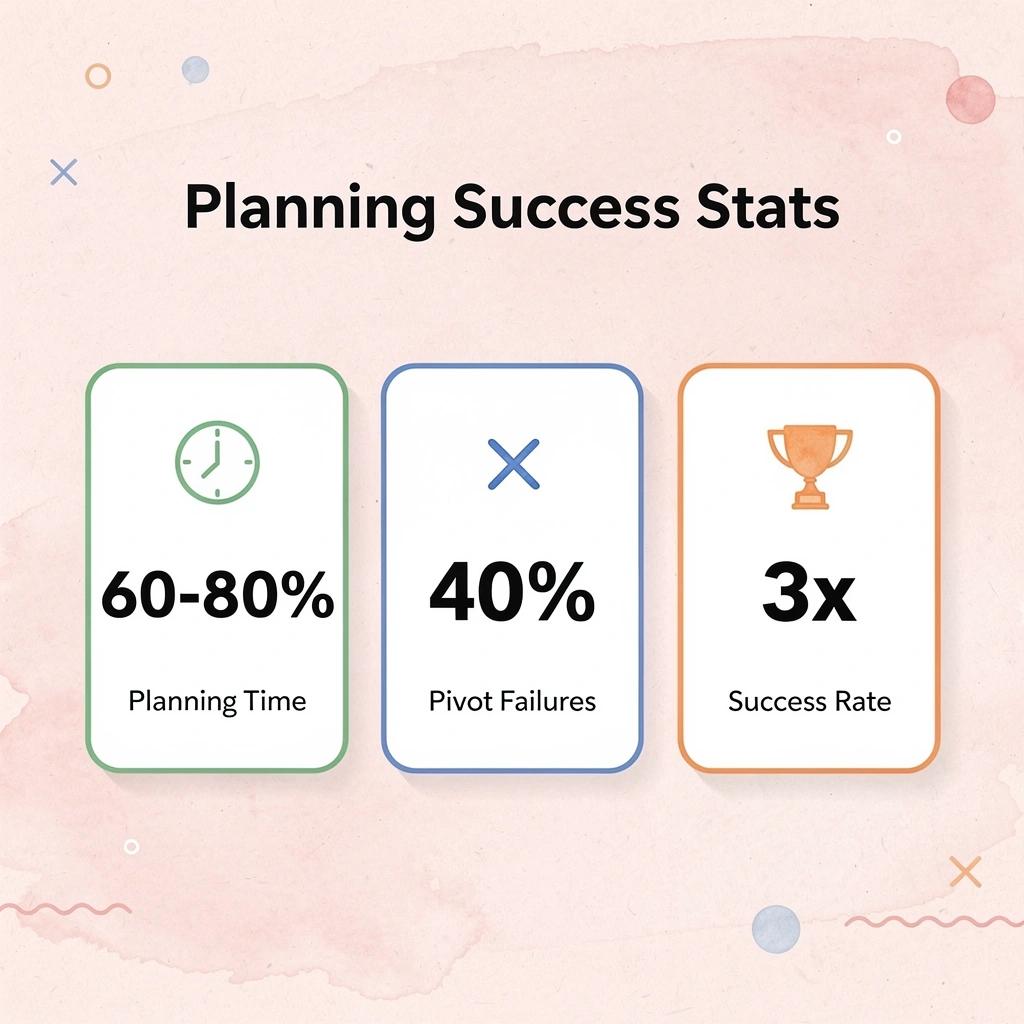
💡 Best Practice: Think of pre-development planning as insurance for your startup. The weeks you invest in market research, user interviews, and technical planning can save you months of expensive development work and potential product-market fit disasters.
They Validate Demand Before Building
One of the biggest mistakes first-time founders make is assuming that because a problem exists, people will automatically pay for a solution. Successful founders test this assumption early by talking to potential customers, studying existing alternatives, and looking for evidence that people are actively searching for a solution or already spending money to solve it.
This validation work may feel less exciting than building a product, but it significantly reduces risk. Successful founders first ask, "Should this be built?" rather than "Can this be built?"
They Define the MVP Carefully
One of the most valuable skills in entrepreneurship is deciding what not to build. Successful founders focus on identifying the smallest version of the product that solves a meaningful problem, rather than imagining dozens of features.
This Minimum Viable Product, or MVP, serves a specific purpose: learning. Founders can launch sooner, gather feedback, and determine whether customers find value in the solution. A well-defined MVP reduces development costs while accelerating learning.
How do successful founders approach customer acquisition planning?
Most founders assume they'll figure out customer acquisition after launch, creating a painful gap between working software and a working business. Successful founders consider distribution earlier, thinking through where customers spend time, how they discover new products, and what the onboarding experience will look like.
This planning shapes development decisions because a product designed around referral growth may look different from one built around paid advertising.
What systems can compress the development and growth cycle?
Systems like Polsia accelerate this process by handling roadmap planning, code shipping, and customer acquisition simultaneously. Our platform helps founders move from idea to market-ready product while AI manages development and growth in parallel.
They Test Assumptions Before Writing Code
Every startup is built on assumptions: customers have a particular problem, users will behave in a certain way, and specific features will be valuable.
Successful founders test these assumptions before spending significant money through customer interviews, landing pages, prototypes, waitlists, or manual service versions. The goal is to find where they might be wrong, not to prove they're right.
But knowing what to validate doesn't tell you how the best builders use these insights.
What the Best Startup Builders Do Differently
The founders who build lasting companies treat constraints as design principles. Instead of asking "how do I hire faster?" they ask "what can I validate before spending money?" This transforms the startup into a learning machine that generates evidence before depleting capital.

Founders with past success have a 30% chance of succeeding again, compared with 18% for first-time founders, according to LinkedIn research by Rodrigo Gutierrez (2025). The gap isn't talent—it's pattern recognition. Experienced founders know which assumptions kill startups and test those first, understanding that building without validation creates expensive mistakes, not momentum.
"Founders with past success have a 30% chance of succeeding again versus first-time founders at 18%." — LinkedIn Research by Rodrigo Gutierrez, 2025

🎯 Key Point: The 12% success gap between experienced and first-time founders demonstrates that startup success isn't about having better ideas—it's about knowing which critical assumptions to validate before burning through capital.
🔑 Takeaway: Elite startup builders don't just move fast—they move strategically, using constraints as filters to identify the highest-risk assumptions that could kill their company if left untested.

Planning as a filter, not a formality
Most founders treat planning like paperwork: something to finish quickly so real work can begin. The best builders use planning differently. They plan to eliminate work.
How does strategic planning reduce development costs?
When you clearly define the customer's problem, entire groups of features become unnecessary. When you map the user's journey before writing code, you identify which screens matter and which exist only because competitors have them. Planning becomes a way to reject everything that doesn't directly solve the confirmed problem. This saves months of development time and tens of thousands of dollars in costs.
What questions prevent building something nobody wants?
The strongest startup frameworks force founders to answer hard questions before coding: Who is the customer? What behavior are we trying to change? What's the smallest version that could prove this works? These questions prevent the most common failure mode: building something nobody wants.
Building as hypothesis testing, not feature accumulation
Traditional development treats each feature as progress: ship the dashboard, add notifications, build analytics. The list grows, timelines stretch, and launch dates slide.
How do the best builders approach development differently?
The best builders flip this. They treat building as a series of bets, each testing a specific assumption: Does anyone care about this problem enough to use a rough solution? Will they pay for it? Can we deliver it reliably? Every build cycle answers a question. If the answer is no, the project pivots or stops. If yes, the next question gets tested.
What are the benefits of this testing approach?
This approach shortens the feedback loop. Instead of spending six months building a complete platform only to discover customers want something simpler, founders learn in weeks. The product evolves based on what works rather than on what founders assume will work, reducing wasted effort and lowering the cost of achieving product-market fit.
What operational burden do founders face after launch?
Launching a product introduces a second job: keeping it running. Servers need monitoring, customers need support, marketing campaigns need management, bugs need fixing, and payment systems need reconciliation. Most founders underestimate how much time operations consume after launch.
How can automation reduce operational overhead?
The strongest startup systems use automation and integration to eliminate repetitive work. Customer questions are automatically routed to the right place and answered without manual sorting. Marketing runs on its own schedule rather than requiring daily attention from the founder. Infrastructure scales automatically without constant oversight. This frees teams from tasks that don't require strategic thinking.
Why should founders delegate operational tasks?
Platforms like web app development company handle these operational layers, managing everything from code deployment to customer service without requiring founders to build internal teams. Our platform protects founder time by automating repetitive support tasks, so you can focus on talking to potential customers and refining your product instead of answering the same question repeatedly. Automation preserves your ability to focus on what moves the business forward.
Why do traditional development phases create friction?
When planning, building, launching, and operating occur as separate phases with different tools and people, friction multiplies. Handoffs create delays, context gets lost between systems, and founders spend more time coordinating than creating.
How does integrated execution eliminate boundaries?
The best startup builders break down these walls. The same system that defines the MVP also ships code, launches marketing, and handles support. Fewer handoffs mean faster execution. Integrated data means better decisions. One source of truth eliminates the need for reconciliation among the roadmap, code, and customer experience.
What creates the compounding effect over time?
This integration creates a compounding effect over time. Each learning cycle accelerates because less time is lost in translation. Each improvement reaches customers faster because fewer steps exist between decision and deployment. The startup becomes more responsive, more efficient, and more likely to find the right combination of features and positioning.
But knowing these principles doesn't tell you how to apply them without first building a traditional team.
Related Reading
- Softr Alternatives
- Replit Alternatives
- Mobile App Ideas
- Appsheet Alternatives
- Devin Ai
- Ai Tools For Product Managers
How Polsia Helps Founders Launch Without Hiring an App Developer
The execution problem extends beyond writing code to include planning, acquiring customers, running the business, and supporting customers. Solving only the development part leaves founders managing four or five other critical functions, each requiring specialized knowledge.

🎯 Key Point: Development is just one piece of the startup puzzle - founders need comprehensive solutions, not just code.
"Solving only the development part leaves founders managing four or five other critical functions, each needing specialized knowledge."

💡 Tip: Look for platforms that address multiple startup challenges simultaneously, not just the technical development aspect.
Startup Functions & Required Specialized Knowledge
- Planning
- Specialized knowledge required:
- Market research
- Competitive analysis
- Business strategy development
- Purpose: Validate opportunities and define a clear path to growth
- Specialized knowledge required:
- Customer acquisition
- Specialized knowledge required:
- Marketing
- Sales funnels
- Lead generation
- Conversion optimization
- Purpose: Attract, convert, and retain customers efficiently
- Specialized knowledge required:
- Business operations
- Specialized knowledge required:
- Finance
- Legal
- Compliance
- Process management
- Purpose: Ensure the business operates efficiently and remains compliant
- Specialized knowledge required:
- Customer support
- Specialized knowledge required:
- Service systems
- Customer success
- Retention strategies
- Purpose: Maintain customer satisfaction and reduce churn
- Specialized knowledge required:
- Development
- Specialized knowledge required:
- Software engineering
- Product architecture
- Coding and technical implementation
- Purpose: Build and maintain the product or platform
- Specialized knowledge required:

How does Polsia address the full business lifecycle?
Polsia addresses this by working as an independent system for the complete lifecycle of building and running a software business. It starts with planning, helping founders organize ideas into executable roadmaps before coding begins, eliminating the mistake of building features nobody needs.
What results can founders achieve with automated development?
Once planning is complete, the platform builds the product itself. Full-stack development happens within the system, removing the need to hire developers, coordinate freelancers, or search for technical co-founders. According to the Context Studios Blog, one solo founder reached $1M ARR in 30 days using this approach: speed gained by eliminating coordination overhead and moving directly from decision to deployment.
How do you bridge the gap between product development and customer acquisition?
Building the product solves one challenge. Attracting customers creates another. Most founders discover this gap after launch, when shipping code gives way to empty inboxes and silent landing pages.
Polsia extends into marketing execution by running cold email campaigns, managing Meta advertising, and handling social media marketing. Founders coordinate these activities through the same system that built their product, enabling faster iteration on messaging and positioning with fewer handoffs between strategy and execution.
What happens when customer communication becomes overwhelming?
As businesses grow, customer communication consumes time and resources. Support requests pile up, consuming hours that could be spent on product decisions or business development. Polsia handles inbox management and customer communication, reducing repetitive work and freeing operations to run more efficiently.
Continuous Execution Without Traditional Constraints
Traditional hiring depends on availability mismatches: developers work set hours, marketers operate within schedules, and founders building companies while holding full-time jobs struggle to align when work needs to happen with when people are available.
Polsia executes tasks around the clock without requiring founders to be present. For entrepreneurs launching businesses in the evenings and on weekends, progress continues even when attention shifts elsewhere, compressing timelines that would otherwise stretch over months.
AngelsRound reports the platform has raised $30M while operating with zero employees. The work still happens; the coordination overhead disappears.
How does this approach reduce financial risk?
The traditional model requires assembling a team before validating market demand. Founders spend money on salaries, equity, and infrastructure before knowing whether customers will buy the product.
Starting at $49 per month, Polsia flips this around. Founders can validate ideas faster and spend less before receiving market feedback. If the idea fails, losses remain minimal. If it succeeds, the system scales without first requiring a traditional team structure.
What coordination advantages does this provide?
The bigger advantage is eliminating coordination friction across multiple disciplines. Planning, development, marketing, operations, and support all happen within a single system, reducing time lost translating decisions into action across different teams and tools.
Related Reading
- Best Vibe Coding Tools
- Ai App Builders
- Mobile App Ideas
- Lovable Ai
- How To Create An App
- Best Mobile App Builder
- No Code Ai Tools
Start or Grow your Existing Business with Polsia Today
The difference between thinking about a business and running one is execution. You need a system that moves from decision to deployment without waiting on others, managing handoffs, or translating your vision across multiple specialists.

💡 Tip: Skip the traditional hiring bottleneck and start executing your vision immediately with autonomous systems that handle the heavy lifting.
Polsia operates as your autonomous co-founder, handling the full cycle of building and running your company. It plans your roadmap, ships production code, launches ad campaigns, responds to customer inquiries, and manages outreach across channels. You define the direction, and the system executes continuously without requiring you to hire, onboard, or coordinate a team.
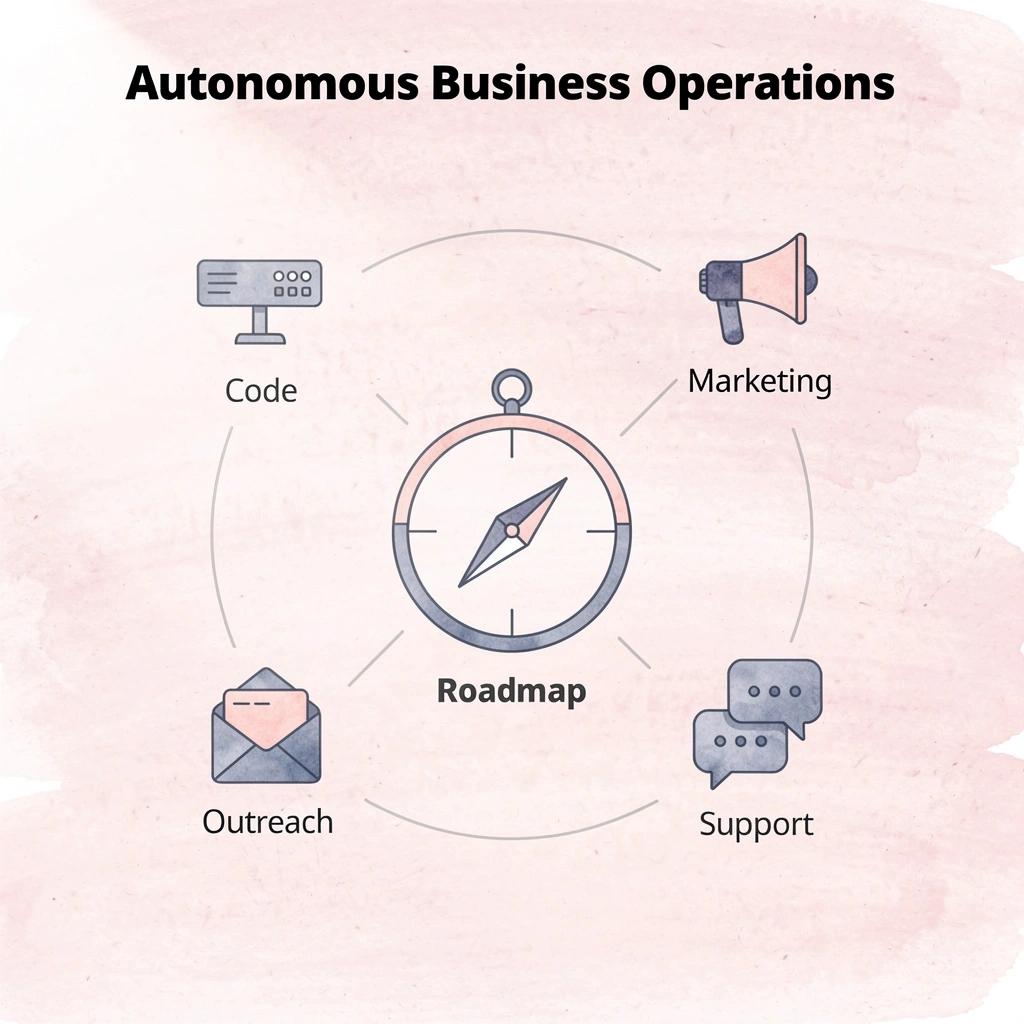
"You can begin tonight and wake up to progress that would normally require weeks of recruitment and ramp-up time." — The new reality of autonomous business execution
Start your first session today. Focus on defining your MVP, identifying who will pay for it, and building a launch plan to move you from idea to a live product. You can begin tonight and wake up to progress that would normally require weeks of recruitment and ramp-up time.

🔑 Takeaway: The question isn't whether you can build a business without a traditional team—it's whether you're ready to operate differently than most founders expect.